
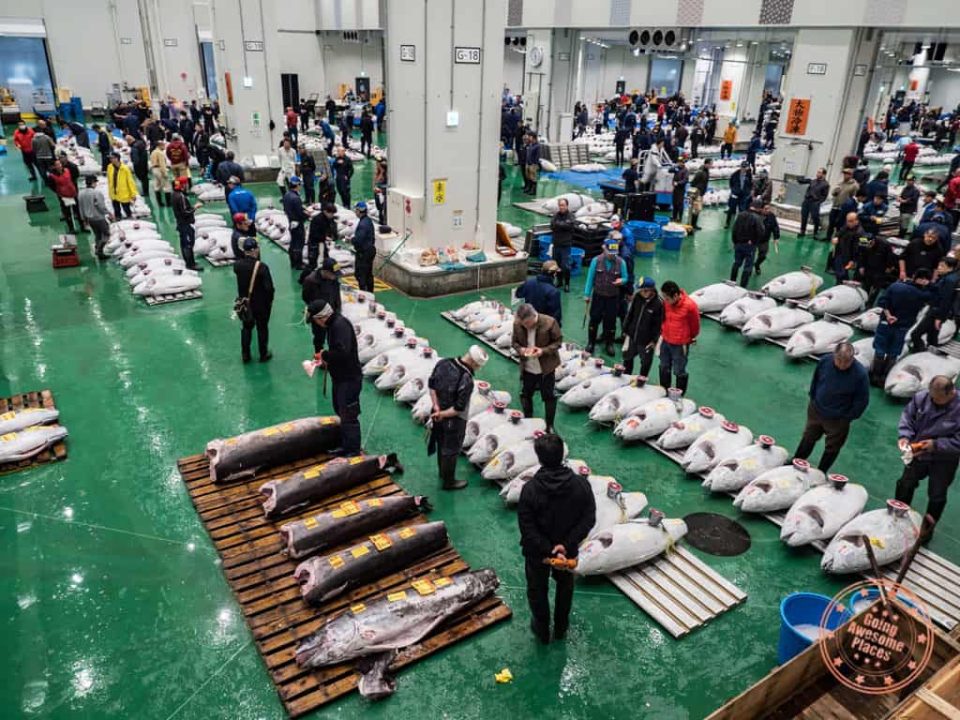
The Theatre of Commerce
The Japanese fish market represents perhaps the most fascinating collision of ancient tradition and modern commerce on earth, a daily ritual that begins long before dawn when buyers in white rubber boots gather to inspect the day’s offerings with pocket torches and experienced eyes. In Tokyo’s legendary Toyosu Market, which replaced the historic Tsukiji in 2018, fortunes change hands in seconds with subtle finger gestures and nods, a silent language comprehensible only to initiates of this closed economic ecosystem. Beyond its practical function, the market serves as a barometer for ocean health, a stage for international relations, and a battlefield for conservation—all before most citizens have had their morning coffee.
The Cold War of Marine Resources
Behind the orderly rows of gleaming fish lies a complex geopolitical struggle. The market floor, with its carefully demarcated territories and hierarchy, reflects Japan’s post-war economic development and its strategic deployment of soft power through culinary diplomacy.
Critical developments in this system include:
- The 1960s: Japan’s distant-water fishing fleet expansion coincided with American security guarantees
- The 1970s: Introduction of 200-mile Exclusive Economic Zones forced adaptation to new international rules
- The 1980s: Japan’s economic ascendance positioned its fish markets as global price-setters
- The 1990s-2000s: Rising competition from Korean and Chinese buyers disrupted Japanese market dominance
- 2010s-Present: Sustainability concerns and declining fish stocks created new market pressures
“Singapore’s relationship with Japanese fish markets has evolved dramatically since the 1980s,” explains a veteran seafood importer who supplies Singapore’s high-end sushi restaurants. “What was once a one-way trade has become a sophisticated dance. Our buyers now have direct relationships with specific Japanese auction houses, and Singaporean preferences increasingly influence what Japanese exporters prioritise.”
The Auction: A Capitalist Ritual
The pre-dawn tuna auction combines elements of theatre, gambling, and high-stakes diplomacy. Unlike Western commodity markets with their electronic screens and algorithmic trades, the Japanese system maintains human judgment at its centre.
The process unfolds with precision:
- 3:00 AM: Frozen tuna, each weighing up to 250 kilograms, arrive by truck and forklift
- 4:00 AM: Buyers inspect specimens, using specialised hooks to extract small samples of flesh
- 5:30 AM: The auctioneer’s bell signals the start of bidding
- 5:30-6:30 AM: Hand signals and fingered bids determine which restaurant conglomerate or wholesaler secures each fish
- 7:00 AM: Winners arrange transport while losers recalibrate for the next day’s battle
“I’ve attended both Singapore’s Jurong Fishery Port auctions and Tokyo’s tuna auctions,” notes a fisheries economist from a Singapore university. “While our local market is impressive, the Japanese system represents a different category entirely—it’s the Olympics of seafood procurement, where reputation and relationships often matter more than the actual bid.”
The Intelligence Operation
Like Cold War operatives, Japanese market intermediaries maintain extensive networks of informants and contacts throughout the world’s oceans. Information—about catch location, handling methods, fat content, even the captain’s reputation—influences valuation more than any visible characteristic.
This intelligence apparatus extends to Singapore, where:
- Japanese trading companies maintain offices specifically to monitor Southeast Asian fishing developments
- Dedicated seafood couriers operate daily flights between Singapore and Tokyo
- Market specialists cultivate relationships with local fishermen in the region
- Quality assessment experts train Singapore-based inspectors in Japanese grading standards
- Data analysts track consumption patterns in Singapore’s Japanese restaurants
The Conservation Battlefield
The market’s seemingly orderly surface masks an increasingly desperate ecological crisis. Since the 1970s, Pacific bluefin tuna populations have declined by over 97%, yet the auction system—designed for abundance—continues largely unchanged.
International efforts to regulate the trade encounter the impenetrable complexity of the Japanese market system, where:
- Opacity in pricing makes tracking actual values difficult for regulators
- Complex distribution chains obscure the origins of individual fish
- Cultural tradition and national identity create resistance to external regulations
- Economic interdependencies between fishing communities and processors complicate reform
- Consumer expectations for consistent supply ignore biological realities
“Singapore’s position is particularly complex,” explains a marine conservation specialist. “As both a major consumer market and a transit hub, we have responsibilities to ensure that what enters our supply chain is legally sourced. Yet our culinary culture increasingly demands the same products featured in Japanese markets, creating tensions between sustainability and gastronomic aspiration.”
The Uncertain Future
Like the intelligence agencies Hoffman chronicled in his earlier work, the Japanese fish market now faces an existential reckoning. Climate change alters migration patterns. Overfishing depletes stocks. International regulations tighten. Consumer awareness grows. Yet the morning auction continues, adapting incrementally while preserving its core rituals.
The fundamental paradox remains unresolved: the very success of the Japanese market system—its ability to monetise and distribute marine resources efficiently—threatens the future of the resources upon which it depends. In Singapore and across Asia, culinary traditions increasingly incorporate elements that cannot be sustained at current harvesting rates. The path forward will require a delicate balance between cultural preservation and biological necessity—a challenge that will determine whether future generations will know the unique taste of bluefin tuna.
